

 See My Latest Article on HelloNation
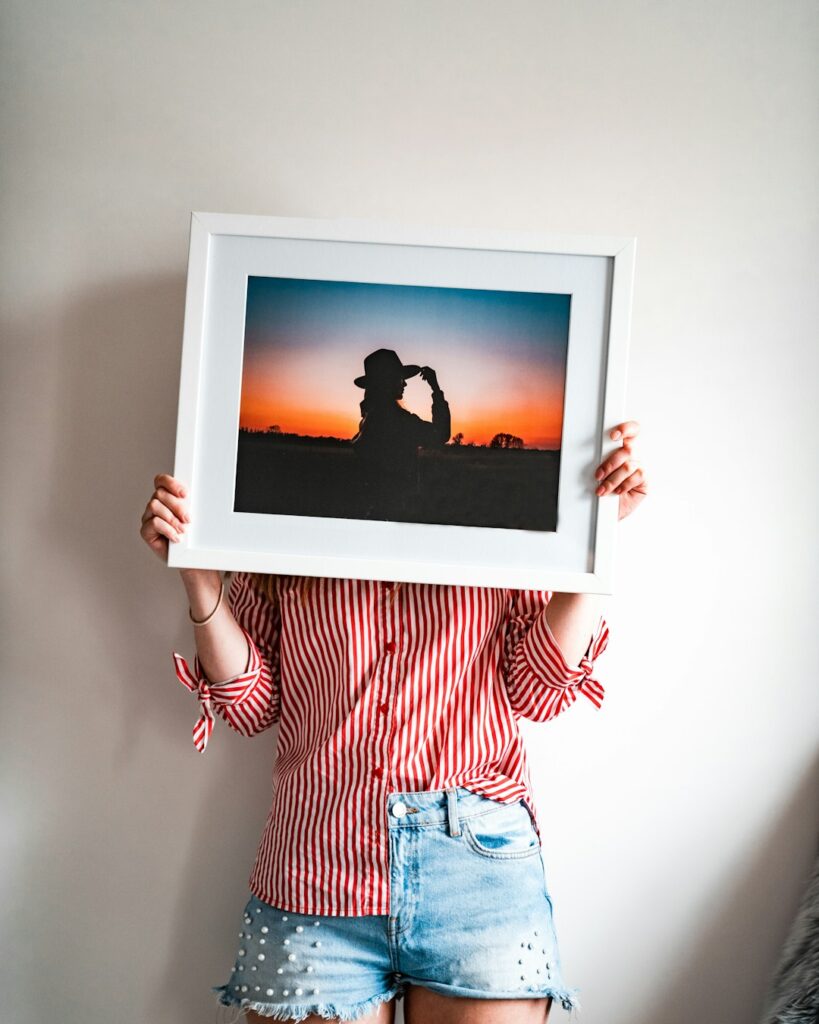
A fine art print usually looks most successful when its size relates to the wall, the furniture beneath it, and the viewing distance. The right dimensions can make a modest room feel balanced, while an oversized or undersized print may appear disconnected from its surroundings.
What size should a fine art print be?
The best size depends on where the print will hang, how much surrounding wall is visible, and whether the artwork should act as a quiet accent or a visual focal point. Measure the display area before choosing a print rather than selecting a size based only on the image itself.
Common finished print sizes include:
- 8 × 10 inches for shelves, desks, small walls, and grouped arrangements
- 11 × 14 inches for bedrooms, offices, hallways, and modest wall sections
- 16 × 20 inches for noticeable wall presence without dominating a room
- 18 × 24 inches or 20 × 30 inches for larger walls and main living areas
- 24 × 36 inches and larger for statement pieces, open walls, and spacious rooms
These measurements describe the finished artwork, not necessarily the paper size. A print with a wide mat and frame will occupy substantially more wall space than the paper alone.
How do you measure a wall for artwork?
Measure both the width and height of the available wall area, then account for furniture, doorways, windows, light switches, and nearby decorations. The usable space is often smaller than the full wall.
For artwork hung above furniture, a finished piece commonly looks balanced when it spans roughly two-thirds to three-quarters of the furniture width. For example, a print or grouped arrangement above a 60-inch-wide console may look proportional when the complete display measures approximately 40 to 45 inches across.
Leave enough breathing room around the art. A narrow wall may need a vertical print, while a wide wall may suit a horizontal image or a small series of related works. If the wall has strong architectural features, such as built-in shelving or exposed structural elements, a simpler and slightly smaller presentation may prevent visual crowding.
A useful test is to cut paper or cardboard to the proposed finished dimensions and attach it temporarily to the wall. This reveals proportion more accurately than looking at a size chart.
Should the frame size or paper size guide the decision?
The frame size should guide the decision because it represents the artwork’s actual visual footprint. Paper size is only one part of the final presentation.
A 16 × 20-inch print may become approximately 22 × 26 inches after adding a mat and frame. A deckled-edge print or a piece floated within a frame may require even more space. Before ordering or printing, determine:
- The paper dimensions
- The visible image area
- The mat border
- The frame’s outer dimensions
- The hanging hardware and clearance needed above furniture
For a clean, contemporary appearance, a narrower mat may be suitable. Traditional or highly detailed artwork often benefits from a wider mat that gives the image room to breathe. The mat should support the composition rather than hide important edges or create an awkwardly tight border.
How does image resolution affect print size?
Print size should be limited by the image’s usable resolution, especially for photographs and digitally created artwork. Enlarging a file beyond its detail capacity can make edges look soft, textures appear smeared, and fine lines lose clarity.
For many high-quality prints, a working resolution near 300 pixels per inch is a useful starting point at the final print size. Some images can print well at lower resolutions when viewed from farther away, while highly detailed artwork may require more information.
For example, a file intended for a 16 × 20-inch print has different requirements from one intended for a 24 × 36-inch print. The larger piece will usually be viewed from a greater distance, but it still needs enough detail to hold up at closer range.

Do not judge resolution only by how large an image appears on a screen. Screens can hide softness through brightness and backlighting. A file should be evaluated at its intended output size, with attention to fine details, edges, and areas of subtle shading.
What size works best in smaller rooms?
Smaller rooms do not automatically require tiny artwork. A single well-proportioned medium print can create more visual order than several small pieces scattered across the wall.
For bedrooms, home offices, entry areas, and compact sitting rooms, 11 × 14 or 16 × 20 inches often provides enough presence without overwhelming the space. A vertical print can emphasize ceiling height, while a horizontal piece can visually widen a narrow wall.
In homes with open floor plans, artwork may be viewed from several distances. A medium or large print can help define a dining area, reading corner, or hallway without requiring a physical divider. The frame finish and mat color should remain compatible with nearby surfaces so the artwork feels integrated rather than isolated.
When is a large print the better choice?
A large print is generally appropriate when the wall is broad, the room has generous sightlines, or the artwork contains a simple composition that benefits from scale. Landscapes, architectural views, botanical studies, and abstract pieces with strong shapes may work particularly well at larger dimensions.
Large prints need enough surrounding space to be read clearly. Placing a 24 × 36-inch piece on a narrow wall between two openings can make the area feel crowded, even if the artwork itself is attractive. Large work also requires careful consideration of glare, frame weight, and hanging height.
In rooms with tall ceilings, a vertically oriented piece may balance the wall more effectively than a small horizontal print. In a long hallway, several smaller works may provide a better rhythm than one large image, especially if viewers will see them at close range while walking.
How should multiple prints be arranged?
A group of prints should be treated as one visual unit. Measure the total width and height of the arrangement, including the spaces between frames, before comparing it with the wall and furniture.
Keep spacing consistent, often between two and four inches depending on the frame size and the room. Larger works can support wider gaps, while small prints usually look more unified with tighter spacing.
A grid arrangement benefits from matching outer dimensions and even alignment. An organic arrangement can mix sizes, but it should still have a clear overall shape. Lay the pieces on the floor first, then photograph the arrangement or create paper templates for the wall.
For a three-print grouping above furniture, the combined width commonly looks balanced when it covers roughly two-thirds to three-quarters of the furniture below. The individual prints do not need to be identical, but their visual weight should be reasonably even.
What local conditions should be considered?
In Ruston, seasonal humidity and temperature changes can affect paper, mats, frames, and hanging surfaces. Artwork should be kept away from direct sunlight, damp areas, heating or cooling vents, and exterior walls that may experience greater temperature fluctuation.
Homes with active air conditioning may still have rooms with changing humidity, particularly near kitchens, bathrooms, laundry areas, or frequently opened doors. Archival-quality paper and matting can help preserve the work, but placement remains important.
Consider how the artwork will be viewed in natural daylight as well as after dark. A print that looks balanced in bright daylight may appear too small under evening lighting. Glare from glass can also obscure darker artwork, so the viewing angle and nearby light sources matter as much as the print dimensions.
The most reliable choice is the size that respects the artwork’s detail, the wall’s proportions, and the way people actually move through the room. Measuring the complete framed presentation before printing prevents many sizing mistakes and makes the finished piece feel intentional.